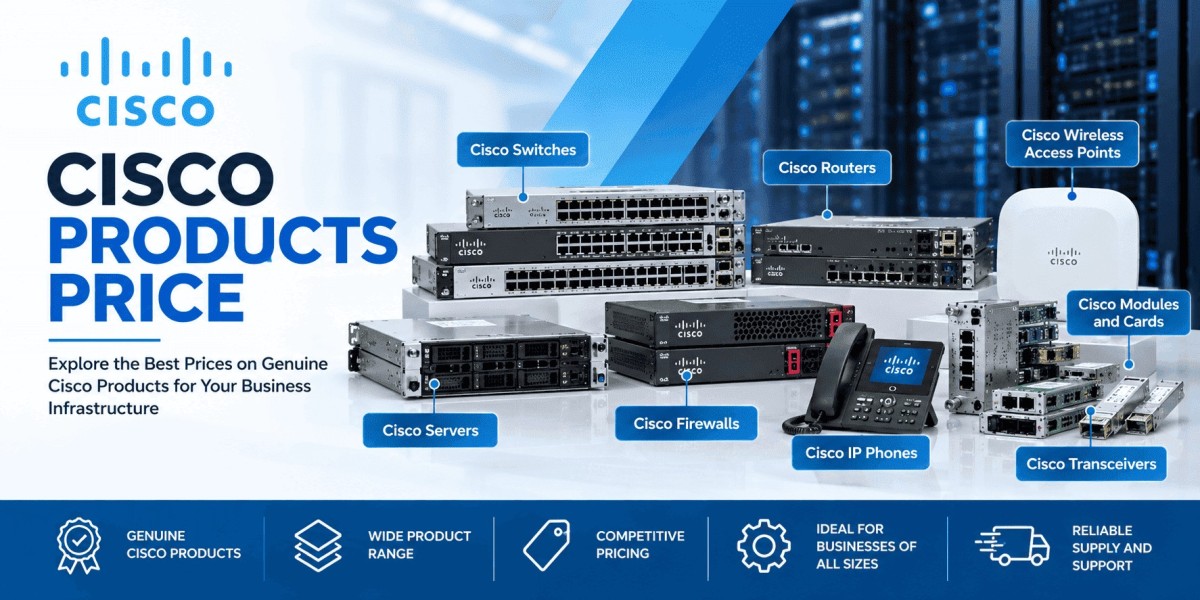

Understanding Cisco products price is essential for businesses planning to purchase reliable networking equipment, upgrade existing infrastructure, or expand their IT environments. Cisco offers a broad portfolio of enterprise networking hardware, including switches, routers, firewalls, wireless access points, transceivers, and network modules. However, prices vary considerably depending on product specifications, performance capabilities, licensing requirements, and whether the equipment is new or refurbished.
For businesses investing in IT infrastructure, choosing the right Cisco equipment involves more than comparing purchase prices. Network performance, compatibility, security features, scalability, and long-term maintenance costs all contribute to the overall investment.
This comprehensive guide explains the factors affecting Cisco product pricing, compares major equipment categories, and explores how businesses can make cost-effective purchasing decisions in 2026.
Cisco Products Price: What Determines the Cost?
Cisco products price varies according to the type of networking equipment, hardware specifications, enterprise features, and software requirements.
Entry-level networking devices generally cost less than enterprise-grade equipment designed for large organisations and data centres.
For example, a basic access switch supporting a small office will typically have different pricing from a high-performance Cisco Catalyst or Nexus switch designed for demanding enterprise workloads.
The number of ports, supported network speeds, switching capacity, security capabilities, and redundancy features can significantly influence pricing.
Software licences and support contracts can also increase the overall investment. Some Cisco products require specific subscriptions or feature licences, making it important to calculate total ownership costs before purchasing.
Product availability, regional distribution costs, and equipment condition may further affect the final quotation.
Understanding Cisco Networking Product Categories
Cisco Switches Price
Cisco switches are essential components of business networks, connecting computers, servers, printers, wireless access points, and other devices.
Cisco offers different switching platforms designed for small businesses, enterprise networks, and data centres.
The Cisco Catalyst 1000 Series has been used in smaller business environments requiring managed access switching. The Catalyst 9200 and 9300 families serve more demanding enterprise access-layer requirements.
Higher-capacity platforms, including Catalyst 9500 switches, support aggregation and core networking applications.
Cisco Nexus switches are designed primarily for data centre environments requiring high throughput, low latency, and advanced networking capabilities.
Cisco switches price depends on port density, supported Ethernet speeds, Power over Ethernet capabilities, stacking features, uplink options, and applicable licensing.
Businesses should also verify product lifecycle status, as older models may be available through secondary-market suppliers but may no longer receive the same software or security support as current platforms.
Cisco Routers Price
Cisco routers connect different networks and help direct traffic between offices, data centres, branch locations, and external services.
Cisco offers routing solutions for small organisations, enterprise branches, service providers, and large-scale network environments.
Cisco Integrated Services Routers have traditionally supported branch connectivity, while Catalyst 8000 Series platforms address modern enterprise routing and secure connectivity requirements.
Cisco routers price varies depending on routing performance, interface availability, WAN connectivity, security capabilities, and software features.
A router designed for a small branch office will generally require a smaller investment than an enterprise platform supporting high-speed connections and extensive traffic management.
When comparing prices, organisations should consider network bandwidth requirements, redundancy, expansion capabilities, and ongoing licensing expenses.
Choosing equipment based only on initial cost may result in insufficient performance as network traffic increases.
Cisco Firewalls Price
Cisco firewalls protect enterprise networks by inspecting traffic, enforcing security policies, and helping prevent unauthorised access.
Cisco Secure Firewall solutions provide security capabilities suitable for different business environments.
Pricing depends on hardware performance, supported throughput, inspection capabilities, high-availability requirements, and associated security subscriptions.
A small organisation with limited traffic may require a different firewall platform from a large enterprise operating multiple locations.
Advanced threat protection and centralised management capabilities can also affect the total cost.
Businesses should consider expected traffic volumes, encrypted traffic inspection requirements, and the number of users or connected devices before choosing a firewall.
The most appropriate firewall offers sufficient protection without creating unnecessary performance limitations or licensing expenses.
Cisco SFP Modules and Transceivers Price
Cisco SFP modules enable network devices to communicate through compatible fibre-optic or copper connections.
These transceivers are commonly installed in Cisco switches, routers, and other networking equipment.
Cisco offers different transceiver technologies, including SFP, SFP+, SFP28, QSFP+, and QSFP28, with specific supported speeds and connection types.
Common applications include Gigabit Ethernet access links, 10 Gigabit uplinks, and higher-speed data centre connections.
Cisco SFPs price depends on transmission speed, optical reach, wavelength, connector type, and compatibility requirements.
Short-range multimode transceivers may have different pricing from long-distance single-mode optical modules.
Before purchasing, businesses should verify whether the transceiver is supported by the intended device, software version, and network configuration.
Selecting an incompatible module can result in additional costs, connectivity problems, or replacement requirements.
Cisco Wireless Access Points Price
Cisco wireless access points provide Wi-Fi connectivity for offices, schools, warehouses, retail stores, and other commercial environments.
Pricing depends on wireless technology, supported Wi-Fi standards, radio capabilities, device capacity, security features, and management requirements.
Enterprise wireless access points may support centralised management, advanced security policies, and high-density wireless deployments.
Businesses should evaluate the physical environment, expected number of connected devices, coverage requirements, and network infrastructure before purchasing.
An access point with advanced specifications may not provide meaningful benefits if the existing network cannot support its capabilities.
Cisco Network Modules and Cards Price
Cisco network modules and expansion cards allow compatible networking equipment to support additional interfaces or capabilities.
Examples include uplink modules, network interface modules, and supported expansion components for selected switches and routers.
Cisco modules price depends on the supported platform, port configuration, interface speeds, and product availability.
Certain modules are designed for specific hardware families and cannot be installed interchangeably.
For example, a network module designed for one Catalyst switch series may not be compatible with another.
Verifying exact part numbers and hardware compatibility is essential before placing an order.
New vs Refurbished Cisco Products: Which Offers Better Value?
When comparing Cisco products price, businesses often evaluate new equipment against refurbished or remanufactured alternatives.
Buying New Cisco Products
New Cisco equipment is generally suitable for organisations requiring current hardware platforms, predictable lifecycle support, and appropriate manufacturer-backed services.
New products may also provide access to the latest networking capabilities and improved power efficiency.
However, the total purchasing cost can be higher once software licences and support arrangements are included.
Buying Refurbished Cisco Products
Refurbished Cisco equipment can provide cost savings, particularly for businesses maintaining established infrastructure.
Older switches, routers, and modules may remain useful for compatible network environments where their capabilities meet operational requirements.
However, third-party refurbished equipment should be evaluated carefully for authenticity, condition, software entitlement, and support eligibility.
Cisco also operates its Cisco Refresh programme, which supplies manufacturer-certified remanufactured equipment with warranty and service support options equivalent to those available for corresponding new products.
Frequently Asked Questions - Cisco
+1
Cisco Refresh should not be confused with independently refurbished equipment sold through other suppliers.
Businesses should request accurate information about the equipment's condition, included accessories, licensing, warranty, and product lifecycle before purchasing.
How Cisco Licensing Affects Product Pricing
Cisco software licensing can represent a significant component of enterprise networking costs.
Certain networking platforms use licences or subscriptions to enable specific functionality, security capabilities, or management services.
The exact requirements depend on the product family, hardware model, and software architecture.
For example, some Catalyst switching platforms include network feature licences alongside applicable Cisco subscription requirements.
Security equipment may also involve subscriptions for threat intelligence, advanced inspection, or other services.
Businesses should confirm which licences are included in the quotation and whether additional renewals will be necessary.
Understanding licensing requirements helps prevent unexpected expenses after deployment.
Factors That Influence Cisco Products Price in 2026
Hardware Performance and Specifications
Equipment with higher port density, faster interfaces, greater forwarding capacity, and advanced features generally commands higher prices.
Businesses should match technical specifications to actual network demand.
Product Availability and Lifecycle
Pricing can change when product models become less widely available or approach important lifecycle milestones.
Legacy equipment may sometimes become expensive because replacement stock is limited.
Software and Support Requirements
Software subscriptions, technical support contracts, and replacement service levels influence total costs.
Cisco notes that standard hardware warranty coverage generally differs from the operational assistance available through separate support agreements.
Cisco
Supplier and Purchasing Channel
Product quotations may differ according to supplier arrangements, stock availability, warranty terms, and delivery requirements.
Businesses should compare the complete commercial offer rather than simply the displayed equipment price.
Regional Pricing and Currency
Cisco equipment costs can vary across regions because of exchange rates, import duties, taxes, shipping expenses, and distribution arrangements.
International buyers should confirm their final landed costs before making purchasing decisions.
How to Choose Affordable Cisco Networking Hardware
Evaluate Your Network Requirements
The first step is understanding the number of connected devices, required bandwidth, network architecture, and expected future growth.
Businesses should avoid purchasing expensive capabilities that their infrastructure does not require.
Check Hardware Compatibility
Cisco networking products must work with existing switches, routers, transceivers, and software versions.
Compatibility checks can prevent unnecessary replacements and implementation delays.
Compare Total Cost of Ownership
Initial equipment pricing does not reflect every cost associated with enterprise networking.
Businesses should consider licensing, support contracts, installation, electricity consumption, maintenance, and future upgrades.
Consider Refurbished Equipment Carefully
Refurbished products may reduce initial expenditure, but buyers should verify authenticity, hardware condition, support eligibility, and warranty coverage.
Plan for Future Scalability
Selecting equipment with suitable expansion capabilities can help avoid premature replacements.
However, purchasing significantly more capacity than necessary may increase costs without delivering immediate value.
Why Choose ORM Systems for Cisco Products?
ORM Systems is an IT hardware and solutions provider offering networking equipment and enterprise infrastructure products for business procurement requirements.
Its product portfolio includes Cisco switches, routers, transceivers, network modules, and other networking hardware.
Businesses comparing Cisco products price can benefit from evaluating available equipment specifications, product condition, compatibility, and warranty arrangements before ordering.
ORM Systems serves organisations seeking hardware for network expansion, infrastructure maintenance, equipment replacement, and enterprise IT procurement.
When purchasing Cisco products, customers should request a quotation based on the exact manufacturer part number, required quantity, equipment condition, and delivery location.
This helps ensure that the selected equipment matches both technical requirements and purchasing budgets.
Frequently Asked Questions About Cisco Products Price
How Much Do Cisco Products Cost?
Cisco product prices vary depending on equipment type, specifications, licensing, condition, and availability. Enterprise routers, switches, and firewalls generally have different pricing structures. An accurate quotation requires the specific model or manufacturer part number.
Why Are Cisco Networking Products Expensive?
Cisco enterprise products may include advanced networking capabilities, security features, management functionality, and hardware designed for demanding environments. Software licensing and technical support can also influence the overall investment.
Are Refurbished Cisco Products Cheaper Than New Equipment?
Refurbished equipment is often available at lower initial prices, although the savings depend on model, condition, availability, and support arrangements. Buyers should compare total ownership costs and verify licensing before purchasing.
What Is the Price Difference Between Cisco Catalyst and Nexus Switches?
Catalyst and Nexus switches serve different networking environments. Prices depend on individual models, port configurations, performance capabilities, and licensing. Comparing exact specifications provides a more meaningful assessment than comparing product families alone.
Do Cisco Products Require Additional Software Licences?
Some Cisco products require software licences or subscriptions for particular features, management capabilities, or security services. Licensing requirements vary by platform and should be confirmed before purchasing.
Can Businesses Buy Used Cisco Networking Equipment?
Yes, used Cisco networking hardware is available through secondary-market suppliers. However, organisations should verify authenticity, condition, software licensing, warranty, and support eligibility before deployment.
How Can I Find the Best Cisco Switches Price?
Identify the required model, port count, network speeds, PoE requirements, and licensing. Compare quotations for the exact part number and confirm whether accessories, warranties, and support are included.
Are Cisco SFP Modules Compatible With Every Cisco Switch?
No. Cisco transceiver compatibility varies by switch model, software release, interface type, and supported optics. Businesses should consult the applicable compatibility information before purchasing.
Is Cisco Equipment Suitable for Small Businesses?
Yes. Cisco offers networking solutions for different organisational requirements, including smaller offices and enterprise environments. The appropriate equipment depends on budget, network size, technical needs, and available IT expertise.
What Should Businesses Check Before Ordering Cisco Products?
Businesses should verify the manufacturer part number, hardware specifications, condition, included accessories, software requirements, warranty terms, support eligibility, product lifecycle, and delivery arrangements.
Conclusion
Understanding Cisco products price helps businesses make informed decisions when purchasing switches, routers, firewalls, wireless access points, transceivers, and other networking hardware.
Cisco equipment pricing varies according to performance, specifications, licensing, availability, and product condition. Consequently, comparing prices without considering operational requirements can lead to unnecessary expenditure or compatibility problems.
Businesses should evaluate network performance, total ownership costs, support requirements, and future scalability before selecting equipment.
New Cisco products may be appropriate for organisations prioritising current platforms and long-term support, while carefully selected refurbished equipment can provide value for compatible infrastructure requirements.
Working with an enterprise hardware supplier such as ORM Systems can help organisations identify suitable Cisco networking equipment and compare available purchasing options.
The best Cisco products price is not necessarily the lowest quotation. It is the investment that delivers reliable performance, verified compatibility, appropriate support, and lasting value for your business.